_edited.jpg)
Cook v. Rockwell: 27 Years, a $375 Million Settlement — and Who Ultimately Paid


For people who lived near Rocky Flats, the FBI raid on June 6, 1989, brought national attention to questions the surrounding community had been living with for years. What had been released from the plant? Where had it gone? And what did that mean for the people and property outside its boundaries?
Months after the raid, neighboring property owners took some of those questions to court. In January 1990, they filed what became Cook v. Rockwell International Corp., alleging that plutonium released from Rocky Flats had traveled beyond the plant boundary, contaminated surrounding properties and diminished their value.
They could not have known then that the case would still be alive more than a quarter-century later.
The lawsuit became an enormous undertaking involving years of discovery, government records, scientific evidence and expert testimony. It took approximately 15 years just to reach trial. When it finally did in 2005, the jury heard four months of testimony before returning a verdict for the property owners on nuisance and trespass claims.
The award was substantial: approximately $176.8 million in compensatory damages and $200 million in punitive damages. With prejudgment interest and other calculations, the district court eventually entered a judgment exceeding $926 million.
For the property owners, however, winning the jury verdict did not mean the fight was over.
Dow and Rockwell appealed. In 2010, the Tenth Circuit vacated the judgment over issues involving the legal framework under which the case had been tried. The litigation continued, and the property owners eventually appealed again. In 2015, they won another important appellate ruling involving their Colorado nuisance claim, breathing new life into a case that was already 25 years old.
By then, another round of litigation remained possible. Instead, the parties reached an agreement.
In May 2016, Cook v. Rockwell settled for $375 million.
That number made headlines, and understandably so. After decades in court, hundreds of millions of dollars would be placed into a settlement fund for claims involving property surrounding one of the nation's former nuclear weapons facilities.
But the headline left out a fascinating part of the story.
Who actually paid the $375 million?
Following the Money
To understand the answer, you have to go back to the unusual relationship between Rocky Flats and the companies that operated it.
Rocky Flats was not a Dow plant or a Rockwell plant in the ordinary sense. It was a United States government nuclear weapons facility. The federal government owned it, while private contractors—including Dow and later Rockwell—operated it under federal contracts.
Those contracts included indemnification protections, and when the Cook case was finally settled, those protections mattered.
The settlement allocated $243.75 million to Rockwell and $131.25 million to Dow. Read casually, those numbers make it sound as though the two companies were writing checks totaling $375 million to resolve the case.
They weren't.
Rockwell later disclosed that the Department of Energy fulfilled its indemnification obligation by paying $243.75 million. Its SEC filing is remarkably direct about the result: Rockwell said it “was not required to make any payment under the settlement agreement.”
Dow's financial disclosures tell a similar story. The company reported receiving full federal indemnification for its approximately $131 million share of the settlement.
So one of the most important facts about Cook v. Rockwell is also one of the easiest to miss: Dow and Rockwell were the defendants, but they did not ultimately bear the financial cost of the $375 million settlement. The federal government did.
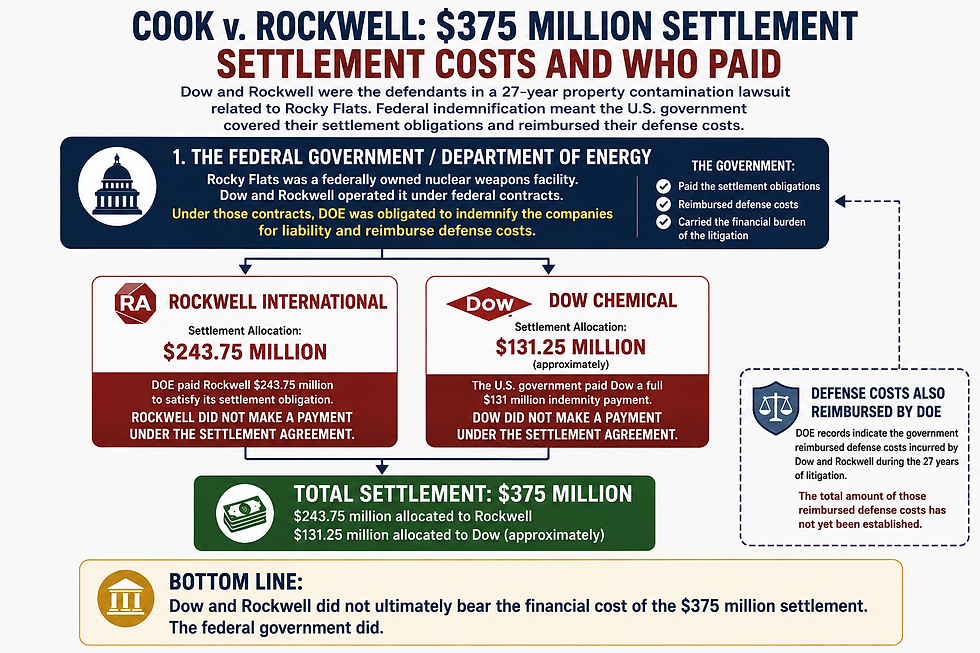
The settlement allocated $243.75 million to Rockwell and $131.25 million to Dow. Federal indemnification ultimately shifted those settlement costs to the U.S. government.
And even $375 million may not tell us the full public cost of the case. Department of Energy records indicate that DOE also reimbursed costs incurred defending the litigation. After 27 years of discovery, expert testimony, trial and appeals, those costs are an important part of the story—but we have not found a complete accounting of them. Rather than guess, we'll leave that number where the records currently leave it: unknown.
Where Did the $375 Million Go?
Following the money in the other direction raises a different question. If the federal government ultimately funded the settlement, how much of the $375 million actually reached the property owners?
The answer is more complicated than the headline suggests.
The money was placed into a court-supervised settlement fund, rather than simply being divided among the people in the class. The federal court approved $150 million in attorneys' fees, equal to 40% of the original settlement fund. Approximately $7.1 million in litigation expenses was separately sought for costs accumulated during the long life of the case. Class counsel was also entitled to a proportionate share of interest earned by the settlement fund, although we have not found a final accounting that tells us how much that ultimately amounted to.

More than $204 million is documented as having been distributed to eligible property owners. Other portions of the settlement went toward court-approved attorneys' fees and expenses.
The distributions to property owners happened in stages. By October 2018, the settlement administrator reported that more than $107 million had been distributed to 8,460 verified claimants. Another distribution of more than $97 million followed that December. Together, those two rounds account for more than $204 million distributed to eligible property owners.
That puts the enormous $375 million headline into a different perspective.
Individual property owners were not receiving million-dollar settlements. Payments varied according to the settlement formula and qualifying property values. Before distributions began, lead plaintiffs' attorney Merrill Davidoff said the largest individual awards were expected to be around $20,000. One property owner interviewed at the time expected to receive about $12,000.
The first major documented distribution—more than $107 million among 8,460 claimants—averages roughly $12,650 per claimant for that distribution alone. That isn't the amount every claimant received, and later distributions added to recoveries, but it gives some sense of scale that the phrase “$375 million settlement” does not.
There are still pieces of the financial picture we would like to understand better. The settlement fund earned investment income while claims were processed, and class counsel was entitled to a proportionate share of that interest in addition to the $150 million fee. The fund also had administrative expenses and tax obligations. We have not yet found a final accounting that reconciles every dollar of principal, investment income and final distributions.
That is why we think it is more responsible to say what we know—and identify what we still don't—than to force the numbers into a tidy equation.
One other distinction is worth making. Cook resolved property claims, not claims for cancer, illness or other health effects associated with Rocky Flats. The settlement did not provide health compensation or medical monitoring for Rocky Flats Downwinders.
What the Settlement Ultimately Tells Us
There is something unusual about following Cook v. Rockwell all the way from the courthouse back to the source of the money.
Property owners spent 27 years pursuing claims against the private companies that had operated Rocky Flats. They survived years of litigation, won a major jury verdict, saw that judgment vacated, continued their case and eventually reached a $375 million settlement.
But when the financial trail is followed to the end, it leads back to the federal government.
The government owned Rocky Flats. Private contractors operated it. Federal contracts protected those contractors from the ultimate financial cost of the settlement, and DOE records indicate that government funds also reimbursed costs associated with defending the litigation.
Meanwhile, the property owners who pursued the case received varying individual recoveries, with the largest initially expected to be around $20,000.
None of that changes what the courts decided at various stages of the case, and it doesn't turn a complicated 27-year lawsuit into a simple story of winners and losers.
But it does reveal something important about Rocky Flats.
Responsibility for operating the plant could be contracted out. The financial consequences ultimately came back to the public.
That tension—between who operated Rocky Flats, who lived with its consequences, and who ultimately bore the cost—is part of the history too.
Examine the Evidence
For readers who want to go beyond our summary, these are some of the records we used to understand the case.
Cook v. Rockwell — U.S. District Court opinion — Background on the litigation, contamination allegations and legal claims.
Rockwell Automation — SEC filing — Rockwell's disclosure of its settlement allocation and DOE indemnification.
Dow — SEC filing — Dow's disclosure concerning its settlement share and federal indemnification.


Comments