_edited.jpg)

INSIDE ROCKY FLATS
To understand what happend outside the plant, fist understand what happened inside.
For nearly four decades, Rocky Flats manufactured plutonium components for the United States nuclear weapons arsenal.
Behind the plant's walls was a complex industrial operation involving radioactive materials, chemical processing, precision manufacturing and thousands of workers. Those operations also generated radioactive and hazardous wastes that had to be recovered, treated, stored or disposed of.
To understand the environmental history of Rocky Flats, we first need to understand what the plant actually did.
01 — THE MISSION
What Did Rocky Flats Make?
Rocky Flats was part of a nationwide network of facilities that designed, produced, assembled and maintained the United States’ nuclear weapons arsenal. Its specialized mission included manufacturing plutonium components that formed the core of nuclear weapons.
Rocky Flats did not build complete nuclear weapons. Materials and components moved among facilities within the weapons complex, with different sites responsible for different stages of production.
That mission required far more than a conventional factory. Radioactive materials had to be handled and contained. Metals had to be cast and machined to precise specifications.
Components had to be inspected. Plutonium-bearing scraps and residues had to be processed, and the wastes created along the way had to be managed.
Rocky Flats was a manufacturing plant, a chemical-processing facility and a nuclear-materials operation operating together on one site.
PHOTO: PLUTONIUM PRECISION-CASTING MOLD · MAY 6, 1959
This mold was used to cast plutonium into ingots for further processing or into shapes suitable for direct machining.


02 — THE MATERIALS
Materials That Shaped the Plant
Plutonium was at the center of Rocky Flats’ nuclear weapons mission, but it was far from the only material handled inside the plant.
Rocky Flats also worked with uranium—including enriched and depleted uranium—beryllium, stainless steel, aluminum and a wide range of chemicals used in manufacturing, metal finishing, plutonium recovery and waste treatment.
These materials created very different hazards. Radioactive materials required controls to limit contamination and exposure. Fissile materials had to be handled and stored to prevent an unintended criticality. Beryllium presented serious occupational health hazards, while chemical processes introduced corrosive, toxic and flammable substances.
The materials themselves helped determine how the plant was designed, how work was performed and how workers were protected.
PHOTO: WORKER HOLDING A PLUTONIUM “BUTTON” · SEPTEMBER 19, 1973
A Rocky Flats worker holds a “button” of plutonium metal through the gloves of a containment box.
03 — PRODUCTION
From Nuclear Materials to Precision Components
Rocky Flats was built for highly specialized manufacturing. Radioactive and non-radioactive metals moved through processes that transformed them into components made to exacting specifications.
Depending on the material and component, that work could include melting and casting, rolling and forming, machining, inspection and testing. Plutonium was fabricated into weapons components, while other operations produced parts from uranium, beryllium, stainless steel and other metals.
Some of the work looked surprisingly familiar: machine shops filled with lathes and precision equipment. Other operations had to be performed inside gloveboxes or specialized enclosed systems because workers were handling radioactive materials.
Manufacturing also created scraps, shavings and residues that still contained valuable plutonium. Instead of simply discarding them, Rocky Flats collected many of these materials and sent them through processes designed to recover plutonium for reuse.
Production and recovery were therefore closely connected: making components also created materials that had to be collected, processed and returned to the production cycle.
PHOTO: MACHINE SHOP · JULY 24, 1970
Workers operate machine tools in a Rocky Flats machine shop. By 1966, according to the HAER record, the shop primarily handled stainless-steel components that were formed into their final shapes.


04 — CONTAINMENT
Keeping Nuclear Material Under Control
Handling plutonium safely required more than containing it during manufacturing. The material also had to be moved, tracked and stored throughout the plant.
Because plutonium is fissile, storage systems were designed to control how much material could be kept in one location and the distance between individual containers. Specialized vaults and equipment allowed workers to store and retrieve plutonium while maintaining those controls.
The X-Y Retriever shown here was one of those systems. Located in Building 707, it automatically sorted and retrieved plutonium metal from a storage vault for distribution to other manufacturing processes.
Containment at Rocky Flats was therefore not a single barrier or piece of equipment. It was a system of engineered controls that followed nuclear material as it moved through the plant.
PHOTO: X-Y PLUTONIUM STORAGE AND RETRIEVAL SYSTEM · NOVEMBER 29, 1988
Inside the X-Y Retriever in Building 707. The automated system sorted and retrieved plutonium metal from a storage vault for distribution to other processes within the building.
05 — RECOVERY
Plutonium Was Too Valuable to Waste
Plutonium didn't disappear when a manufacturing step was finished. Scraps, residues and other materials generated during production could still contain recoverable plutonium.
Rocky Flats developed extensive operations to reclaim it. Plutonium-bearing materials could be collected and chemically processed to separate and purify the plutonium, allowing it to be converted back into metal and returned to the production cycle.
Building 371 was constructed in part to perform this kind of work. Its aqueous recovery system used chemical processes to recover plutonium from materials generated elsewhere in the plant.
Recovery conserved valuable nuclear material, but it also required additional chemicals, equipment and processing—and generated radioactive and hazardous residues of its own.
At Rocky Flats, the effort to recover plutonium became a major industrial operation alongside manufacturing itself.
PHOTO: FIRST PLUTONIUM BUTTON FROM THE BUILDING 371 AQUEOUS RECOVERY SYSTEM · SEPTEMBER 1983
The first plutonium button produced from material processed entirely through Building 371's aqueous recovery operation.


06 — THE PEOPLE
The People Inside Rocky Flats
Behind every process at Rocky Flats were people doing highly specialized jobs. Machinists, chemical operators, engineers, scientists, maintenance workers, radiation-control technicians, security personnel and many others kept the plant operating.
Some jobs looked much like work found in other industrial facilities. Others existed because Rocky Flats handled nuclear materials. Workers operated equipment remotely, reached into gloveboxes, monitored radioactive materials and followed procedures designed to control contamination and exposure.
The work could also connect people to complex systems extending far beyond their immediate workstation. An operator at a control panel might be moving plutonium from secure storage to another part of the building for cutting, weighing, casting or forming.
The story of what happened inside Rocky Flats is also the story of the people who came to work there every day.
PHOTO: X-Y RETRIEVER CONTROL ROOM · MAY 17, 1971
An operator controls the X-Y Retriever used to retrieve plutonium metal from storage in Building 707. The system conveyed plutonium for cutting and weighing before routing it to other areas for casting, rolling or forming.
07 — THE WASTE
The Other Output
Manufacturing nuclear weapons components produced more than the components themselves. Every stage of work at Rocky Flats also generated waste.
Machining created contaminated scraps and residues. Chemical and recovery operations produced plutonium-contaminated liquids and other wastes. Filters, protective clothing, tools and equipment could also become contaminated through use. Materials containing enough plutonium might be processed for recovery; what could not be recovered still had to be treated, stored or disposed of.
Managing that waste became an operation of its own. Rocky Flats developed dedicated facilities and systems to collect, process and store radioactive and hazardous wastes generated throughout the plant.
The products left Rocky Flats. Much of the waste remained.
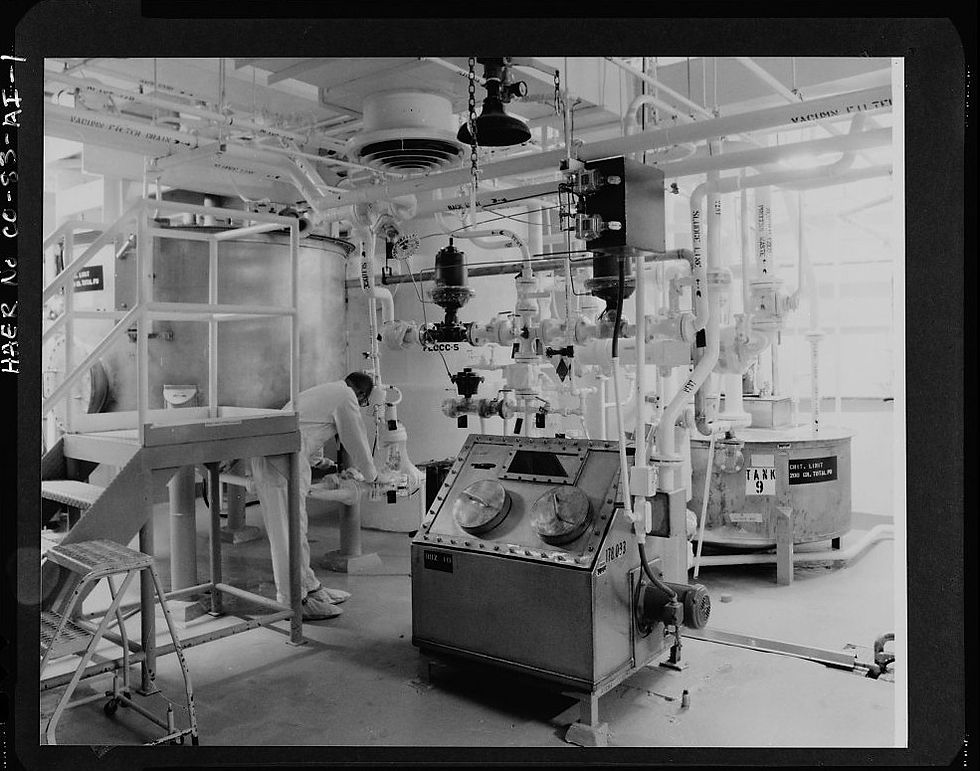
PHOTO: LIQUID PROCESS WASTEWATER TREATMENT · BUILDING 774
Inside Building 774, Rocky Flats' original liquid process wastewater treatment facility. The photograph shows storage tanks containing plutonium-contaminated solutions and a glovebox used by operators to manually control pumps and valves.
.jpg)

08 — THE ACCIDENTS
When Control Failed
Rocky Flats was built around systems intended to control radioactive and hazardous materials. But over decades of operation, those systems did not always succeed.
Fires, leaks, spills and equipment failures occurred inside the plant. The most serious incidents included major plutonium fires in 1957 and 1969, when radioactive material burned inside production buildings and contamination entered ventilation and filtration systems.
Other releases were less dramatic. Contaminated liquids leaked or spilled. Radioactive material accumulated in ventilation systems and equipment. Waste-handling and processing systems created additional opportunities for contamination to move beyond the places intended to contain it.
These events mattered beyond the immediate workplace because Rocky Flats was not a closed system. Air and water that moved through the plant could also provide pathways for contamination to move outside it.
What happened inside Rocky Flats did not always stay inside Rocky Flats.
PHOTO: GLOVEBOX DAMAGED IN THE 1969 PLUTONIUM FIRE · MAY 1969
A glovebox damaged in the May 11, 1969 fire. According to the HAER record, the fire began with the spontaneous ignition of a briquette of scrap plutonium-alloy metal.
09 — THE RELEASES
How Contamination Left the Plant
Rocky Flats was designed to contain radioactive materials, but contamination did not always remain inside its buildings. Releases occurred through several pathways over the plant's operating history.
Air was one pathway. Radioactive particles could enter ventilation systems intended to capture contamination before air was exhausted from a building. During the major plutonium fires of 1957 and 1969, contamination entered these systems; the 1957 fire in Building 771 damaged the filter plenums themselves.
Water and soil provided other pathways. Liquid wastes were treated, stored and discharged through systems connected to the site's ponds and drainage. Leaking waste drums at the 903 Pad contaminated surrounding soil, and plutonium-contaminated soil was later dispersed by wind.
There was no single route by which contamination left Rocky Flats. It moved through air, water and soil—and beyond the places intended to contain it.
PHOTO: FIRE-DAMAGED FILTER PLENUMS · BUILDING 771 · SEPTEMBER 1957
Filter plenums damaged during the September 1957 fire in Building 771, Rocky Flats' Plutonium Recovery and Fabrication Facility.


10 — BEYOND THE FENCE
What Happened Inside Mattered Outside
For nearly four decades, the buildings of Rocky Flats operated as parts of an interconnected nuclear weapons production complex. Materials moved between them for manufacturing, recovery, storage, treatment and disposal.
Those operations also produced radioactive and hazardous wastes, and the systems intended to contain them did not always succeed. Contamination entered the environment through air, water and soil.
Once radioactive material moved beyond the plant, the story was no longer only about what happened inside Rocky Flats. It became part of the history of the land and communities surrounding it.
To understand what happened outside the plant, we first have to understand what happened inside.
PHOTO: THE PLUTONIUM PRODUCTION COMPLEX · JUNE 21, 1988
Aerial view of the central plutonium-production area at Rocky Flats. Building 776/777 dominates the center of the photograph, with Building 771 at lower right and Building 707 beyond it. A solar evaporation pond used as part of Rocky Flats' waste-management system is visible at left.