Who Was the Rocky Flats Stewardship Council Really Representing
For nearly two decades, the Rocky Flats Stewardship Council was responsible for helping communities understand the long-term management of a former nuclear weapons plant. But questions about its independence, leadership, and willingness to include critical voices deserve examination—especially now that the organization has dissolved.
Who was watching over Rocky Flats?
When the accelerated cleanup of Rocky Flats reached physical completion in 2005, the federal government still had significant responsibilities. Residual contamination remained. Groundwater treatment and monitoring would continue. Land-use restrictions and long-term environmental stewardship would be necessary. The surrounding communities needed a way to receive information, question government agencies, and participate in decisions about the former nuclear weapons plant.
In 2006, the Rocky Flats Stewardship Council (RFSC) was established to help fulfill that role.
Its board included local government representatives and selected community organizations and individuals. For nearly two decades, the Council served as a forum for communication among the U.S. Department of Energy (DOE), environmental regulators, local governments, and the public. But a basic question deserves attention: Can a community oversight organization truly represent the public if the people most critical of the agency it monitors struggle to gain a meaningful voice? For Rocky Flats Downwinders, that question is not theoretical. It reflects our own experience.
David Abelson and the Stewardship Council
David Abelson served as the Council's executive director for much of its existence, building on his earlier involvement with the Rocky Flats Coalition of Local Governments. He became a prominent public voice on matters involving the cleanup, long-term environmental monitoring, and plans for the Rocky Flats National Wildlife Refuge. Abelson frequently emphasized the extensive environmental testing conducted at Rocky Flats and the conclusions reached by regulatory agencies.
In a 2016 report about the proposed opening of the wildlife refuge, he was quoted expressing frustration with what he characterized as exaggerated public fears. But his public comments also raised questions about how an organization charged with encouraging community participation should respond to people who remained concerned about the site's environmental history. Those concerns are not necessarily based on misunderstanding or fear. They may reflect firsthand experiences, historical records, disagreements over scientific interpretations, or questions that existing studies have not answered. An organization responsible for public engagement should help bring those perspectives into the conversation. Its role should not be to decide which community concerns are acceptable before those concerns can be heard.
Tiffany Hansen's experience seeking a seat at the table
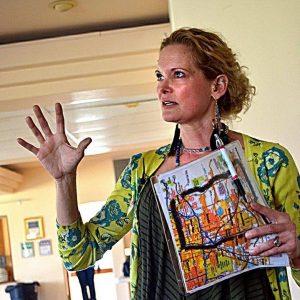
Rocky Flats Downwinders has firsthand experience with the Stewardship Council's membership process. Tiffany Hansen, a leader of Rocky Flats Downwinders, applied to participate on the Council's boar in 2013. She wanted to bring the perspectives of downwinders and families concerned about potential historical exposure and long-term health consequences into discussions about Rocky Flats.
According to Hansen, she participated in an interview as part of the application process.
During that interview, she expressed serious concerns about the Council's independence, including describing it as “bought and paid for.” Hansen's statement reflected her criticism of what she perceived as an overly close financial and institutional relationship between the Council and the Department of Energy. Her application was not accepted.
Should a community representative be excluded from an oversight body because she questions the independence of that body? A healthy public participation process should be able to accommodate disagreement. Indeed, independent oversight is arguably most valuable when it includes people willing to challenge prevailing assumptions. If an applicant raises concerns about financial dependence, those concerns deserve a substantive response.
They should not simply be dismissed because they are uncomfortable. For Rocky Flats Downwinders, the experience reinforced the importance of maintaining an independent voice outside established government advisory structures.
The independence question: Who funded the Council?
The Stewardship Council's relationship with DOE was both formal and financial. The Council served as the designated local stakeholder organization for Rocky Flats, a role established through federal legislation and intergovernmental agreements. Its work included reviewing environmental monitoring, attending briefings, communicating with regulators, and helping the public understand ongoing site activities. DOE funding supported the Council's activities.
That arrangement was publicly disclosed and part of the organization's authorized structure.
Receiving federal funding does not, by itself, establish that an organization lacks independence. But the arrangement creates an important accountability question when the agency providing financial support is also the agency whose performance the organization is expected to scrutinize. What safeguards ensure that funding does not influence the subjects an organization investigates, the questions it asks, or the criticism it is willing to express?
These are reasonable questions for any publicly funded oversight organization. And at Rocky Flats, they were not raised by Rocky Flats Downwinders alone.
Other community advocates questioned the Council
The Rocky Mountain Peace and Justice Center publicly criticized the Stewardship Council's accessibility, transparency, and funding arrangements. In a 2023–2024 public advocacy campaign, the organization called for changes to meeting times and locations, improved public records, and the recording of meetings. It also characterized DOE funding for the Council's executive director as a conflict of interest and called for a different leadership arrangement. Those were the advocacy organization's allegations and demands, not an official finding that Abelson engaged in misconduct. But they demonstrate that concerns about the Council were broader than any single individual's experience. One recurring complaint involved the accessibility of meetings.
Public participation becomes difficult when meetings are held during normal working hours.
People who work full-time, care for children or family members, or cannot easily travel during the day may be effectively excluded from meaningful participation. In February 2024, the Council's own meeting minutes recorded objections to continuing its 8:30 a.m. meetings.
An initial vote on the proposed annual schedule failed to obtain the required support, and the board subsequently adopted only the next two meeting dates while further discussion continued. That is a documented example of community accessibility becoming a contested issue within the Council itself. A meeting may be technically open to the public without being realistically accessible to everyone who wants to attend. For an organization created to encourage public participation, that distinction matters.
The difference between environmental monitoring and community health
The Stewardship Council concentrated much of its attention on ongoing environmental monitoring, groundwater treatment, maintenance of the cleanup remedy, and management of the former site. Those responsibilities were important. However, they were not the same as examining the long-term health experiences of people who lived near Rocky Flats during its operating years. Historical exposure and current environmental conditions are different questions. Monitoring groundwater today cannot, by itself, establish what an individual may have inhaled decades earlier. Likewise, a cancer registry analysis based on geographic residence at diagnosis cannot necessarily describe the long-term health outcomes of everyone who once lived near Rocky Flats.
Rocky Flats Downwinders believes both environmental stewardship and historical health questions deserve serious attention. We are concerned when public discussions about the current condition of the site are treated as though they resolve every question about historical exposure. A regulatory determination that a cleanup remedy is functioning as designed is not a comprehensive assessment of the health experiences of every community surrounding Rocky Flats. These distinctions should be communicated clearly.
Did the Council adequately welcome disagreement?
The Stewardship Council provided access to environmental data, briefings from regulators, and opportunities for local officials and selected community representatives to ask questions.
Those contributions should be acknowledged. At times, the Council also raised concerns about federal management decisions, including proposed refuge activities. Its record was not uniformly supportive of every DOE or federal agency proposal. Nevertheless, its handling of critical community perspectives deserves scrutiny. Were membership opportunities sufficiently open and transparent? How were applicants evaluated? Could organizations that strongly disagreed with federal agencies obtain representation? Were public comments treated as meaningful contributions to the oversight process? And were disagreements over the interpretation of environmental evidence presented fairly to the public?
The experience described by Tiffany Hansen, together with public criticism from other community advocates, suggests that these questions warrant examination. A meaningful community oversight process must make room for people who are skeptical of official conclusions—not simply those who are comfortable working within existing relationships.
The Stewardship Council's final chapter
In early 2024, Abelson announced his retirement after nearly two decades leading the Council. During that year, the organization considered changes to its structure and mission.
Northglenn city staff reported that discussions about restructuring the Council had not succeeded. In late 2024, the Stewardship Council dissolved. The Department of Energy subsequently documented the dissolution and began revising its public involvement procedures. Those developments raise a new set of questions. What lessons were learned from nearly two decades of community oversight? How will DOE ensure that public participation remains meaningful? Who will represent residents concerned about historical exposure? How will independent researchers, former workers, and community organizations obtain access to the records and experts necessary to evaluate continuing questions?
And what safeguards will exist to ensure that future public participation efforts do not repeat the same criticisms? The dissolution of the Council should be an opportunity to examine those questions openly.
Why independent community organizations matter
Rocky Flats Downwinders is a volunteer-driven organization. We do not believe the community should have to depend entirely on government-funded bodies to determine which questions deserve investigation. Our role is different from that of a regulatory agency or a formal government advisory council.
We preserve community stories, examine historical records, advocate for people concerned about exposure, and encourage independent scientific assessment. Our Truth & Transparency initiative reflects that approach. We believe government agencies should explain not only what their studies and monitoring programs found, but also what those efforts cannot establish. That includes acknowledging uncertainty, methodological limitations, gaps in historical records, and legitimate disagreements among qualified experts.
These expectations should apply to government agencies, publicly funded advisory organizations, and independent community groups alike.
Accountability includes listening to those who disagree
The Rocky Flats Stewardship Council existed for nearly two decades. Its leadership and board members devoted considerable effort to following environmental issues and communicating with agencies responsible for the site. But public service does not place an organization beyond criticism.
David Abelson's leadership, the Council's financial structure, its board-selection process, and its approach to public participation are all legitimate subjects for historical examination.
Tiffany Hansen's experience seeking board membership is part of that history. Her criticism was forceful, and others may disagree with it. But her concerns about independence and representation deserve to be heard.
The people who lived in the shadow of Rocky Flats should not be treated as outsiders to conversations about its legacy. They are part of that legacy. As federal agencies develop new public participation arrangements following the Council's dissolution, Rocky Flats Downwinders believes one principle should guide the process: True community engagement must welcome difficult questions, independent voices, and people who are willing to challenge official conclusions. That is how public confidence is earned. And that is what Truth & Transparency should mean.
Sources and Further Reading
U.S. Department of Energy — 2025 Regulatory Contact Record
Official confirmation of the Stewardship Council's dissolution in late 2024 and the resulting revisions to DOE's public involvement process.
City of Northglenn — August 2024
Documents Abelson's announced retirement and the unsuccessful discussions about restructuring the Council.
Rocky Flats Stewardship Council — February 5, 2024
Documents discussions and disagreements over public meeting times and the Council's future.
Rocky Mountain Peace and Justice Center
Documents the organization's criticisms concerning public access, meeting records, and DOE funding.
Boulder County
Provides background on the Council's membership and oversight role.
U.S. Government Accountability Office — 2006
Examines the cleanup's verification process and documents historical concerns about public participation and confidence in federal oversight.


